

Bitter Foods: Waking Up Digestion & Supporting Detoxification
Sweet. Salty. Sour. Umami.
Most of us welcome these flavours without much thought.
But bitter?
Bitter is often the taste we try to avoid. We sweeten bitter drinks, choose milder vegetables and selectively cultivate foods to make them more palatable.
Yet bitterness has been part of the human diet for thousands of years, particularly through wild greens, herbs, roots, citrus peel and other plant foods. Across traditional Mediterranean food cultures, bitter greens weren't unusual ingredients to tolerate, they were simply part of eating.
And when something bitter touches the tongue, your body doesn't simply register a flavour.
It receives information.
Modern research has discovered that the receptors responsible for detecting bitterness are not confined to our taste buds. Bitter taste receptors are found throughout the gastrointestinal tract, where they participate in a much wider network of digestive and metabolic signalling.
Perhaps those bitter greens on the side of the plate were doing more than providing vitamins and minerals after all.
Why Do We Taste Bitter?
Our ability to detect bitterness has deep evolutionary roots.
Humans possess a family of approximately 25 functional bitter taste receptors known as TAS2Rs. Historically, the ability to recognise bitterness is thought to have served partly as a protective mechanism, helping us identify potentially harmful plant compounds before consuming them.
But bitter does not automatically mean poisonous.
Many perfectly edible plants contain naturally bitter phytochemicals, including compounds found in leafy greens, cruciferous vegetables, herbs, olives, citrus and coffee.
This creates an interesting relationship with bitterness.
Our biology tells us to pay attention to it.
But plants have also exposed us to bitter compounds throughout human dietary history.
And increasingly, science is discovering that our bodies do far more than simply taste them.
The Bitter Reflex: Digestion Begins Before Food Reaches the Stomach
We tend to think digestion begins once food reaches the stomach.
It actually begins much earlier.
The sight, smell, thought, and taste of food can initiate what is known as the cephalic phase of digestion, anticipatory signalling that begins preparing the gastrointestinal tract for the food that's about to arrive.
Through predominantly neural pathways, sensory exposure to food can influence salivation, gastric acid secretion, gastrointestinal motility and pancreatic secretions.
In other words, digestion isn't simply a mechanical process that switches on when food lands in the stomach.
Your nervous system is involved before the first mouthful has even been swallowed.
This is one reason traditional herbal medicine has long used bitter-tasting preparations around meals to support appetite and digestion.
However, this is also an area where I think we need to separate traditional practice from what modern research can confidently tell us.
We know that sensory exposure to food initiates digestive responses. We also know bitter compounds interact with specialised receptors throughout the digestive tract.
What we cannot say is that every bitter food automatically causes a predictable increase in stomach acid, digestive enzymes or bile in every person.
The physiology is much more interesting, and much more complex, than that.
Your Gut Can “Taste” Too
One of the most fascinating discoveries in this area is that bitter taste receptors aren't only located on the tongue.
TAS2R receptors have also been identified throughout the gastrointestinal tract.
Here they aren't creating the conscious sensation of bitterness that you experience in your mouth. Instead, they function as chemosensors, detecting compounds within the intestinal environment and participating in communication between the gut and the rest of the body.
Some are found on specialised enteroendocrine cells, cells within the intestinal lining that sense what's arriving in the gut and release signalling molecules in response.
Experimental research suggests bitter receptor activation can influence gastrointestinal hormones and signalling molecules including cholecystokinin (CCK), glucagon-like peptide-1 (GLP-1), peptide YY (PYY) and ghrelin. These are involved in processes such as gastric emptying, appetite, satiety, gastrointestinal motility and metabolic regulation.
Bitter receptors have also been identified on other intestinal cells involved in mucus production, antimicrobial defence and immune signalling.
Suddenly, bitterness starts to look less like an unpleasant flavour and more like another language through which food communicates with our physiology.
Bitterness, Bile & Fat Digestion
Bitter herbs have traditionally been associated with the liver and gallbladder, which is where claims about bitters and “detox” often begin.
But first, let's talk about bile.
Bile is produced continuously by the liver and, when the gallbladder is present and functioning, stored and concentrated there between meals. When food, particularly fat, enters the small intestine, hormonal signalling including CCK helps coordinate gallbladder contraction and the delivery of bile into the intestine.
Bile acids help emulsify dietary fats, allowing pancreatic enzymes to work more effectively and supporting the absorption of fats and fat-soluble vitamins.
Bile also has another important role.
It is one of the routes through which the body can eliminate certain substances that have been processed by the liver.
This helps explain why bitter plants have historically become so closely associated with both digestion and elimination.
There is some human evidence that particular concentrated bitter plant preparations can influence bile flow. For example, a small placebo-controlled pilot study found that a standardised artichoke leaf extract increased bile secretion. But that's evidence for a specific concentrated extract under experimental conditions, not proof that every bitter food produces the same response.
That distinction matters.
Food can support normal physiology without needing to become medicine in disguise.
So Do Bitter Foods Actually “Detox” You?
This is where the word detox needs some cleaning up of its own.
Your body doesn't wait for a juice cleanse, detox tea or bitter salad before it begins detoxifying.
Your liver is continuously transforming endogenous compounds and substances from the environment through sophisticated enzymatic pathways. The kidneys, gastrointestinal tract, lungs and other systems also participate in processing and eliminating metabolic waste and foreign compounds.
So when I talk about supporting detoxification, I'm talking about supporting these normal physiological processes, not “flushing toxins” out of the body.
Food absolutely interacts with these systems.
Certain dietary compounds can influence enzymes involved in biotransformation. Perhaps the best-studied examples come from cruciferous vegetables such as broccoli, rocket, watercress, radish, cabbage and Brussels sprouts. Their glucosinolate-derived compounds can influence enzymes involved in phase I and phase II metabolism, although responses vary according to the food, dose, genetics and other factors. Human dietary intervention research has demonstrated measurable effects on enzymes including CYP1A2 and glutathione S-transferase.
But here's an important distinction:
A food being bitter isn't what automatically makes it “detoxifying.”
Different bitter foods contain different phytochemicals with different biological actions.
Bitterness is a sensory property.
Detoxification is a collection of physiological processes.
The two can overlap — but they aren't interchangeable.
The Mediterranean Relationship With Bitter
This is where the science becomes particularly close to home for me.
Traditional Mediterranean diets have long incorporated flavours that many modern palates might consider surprisingly bitter.
In Greece, perhaps one of the best examples is χόρτα — horta.
Horta isn't one single vegetable. It refers broadly to edible wild greens traditionally gathered according to season, boiled or otherwise prepared, and commonly served simply with olive oil and lemon.
Depending on the region and season, these can include numerous different species, many noticeably bitter.
Research documenting traditional wild-green consumption in Ikaria identified 56 different wild greens, with bitterness particularly prominent among the plants traditionally gathered and eaten. Similar ethnobotanical research in Crete has documented the persistence of wild greens within the traditional diet, including culturally important groups of bitter greens.
Even more recent research from Karpathos documented 69 wild green taxa, with around half described as bitter and bitter plants making up the majority of the most frequently cited greens.
This doesn't prove that bitter greens are the reason Mediterranean dietary patterns are associated with health.
But it tells us something culturally important.
Bitterness wasn't always something we tried to remove from food.
It was part of the flavour landscape.
Have We Lost Our Taste for Bitter?
Walk through a modern supermarket and sweetness is incredibly easy to find.
Bitterness, less so.
Even many vegetables have been selected over generations for qualities such as tenderness, yield, appearance and palatability. At the same time, modern eating patterns increasingly expose us to highly palatable combinations of sweetness, salt and fat.
The result is a palate that may simply encounter genuine bitterness less often.
And taste is adaptable.
Think about the first time someone drinks black coffee, eats a strong olive or tastes radicchio. The bitterness can feel overwhelming.
Then something interesting happens.
We learn the flavour.
The same can happen with dark leafy greens, extra virgin olive oil, citrus peel and other complex plant foods.
Perhaps part of eating a more diverse diet isn't simply learning to eat more vegetables.
It's learning to appreciate a wider spectrum of taste.
Bringing Bitter Back to the Plate
You don't need a bottle of digestive bitters to begin experiencing bitter foods.
They can simply return to the plate.
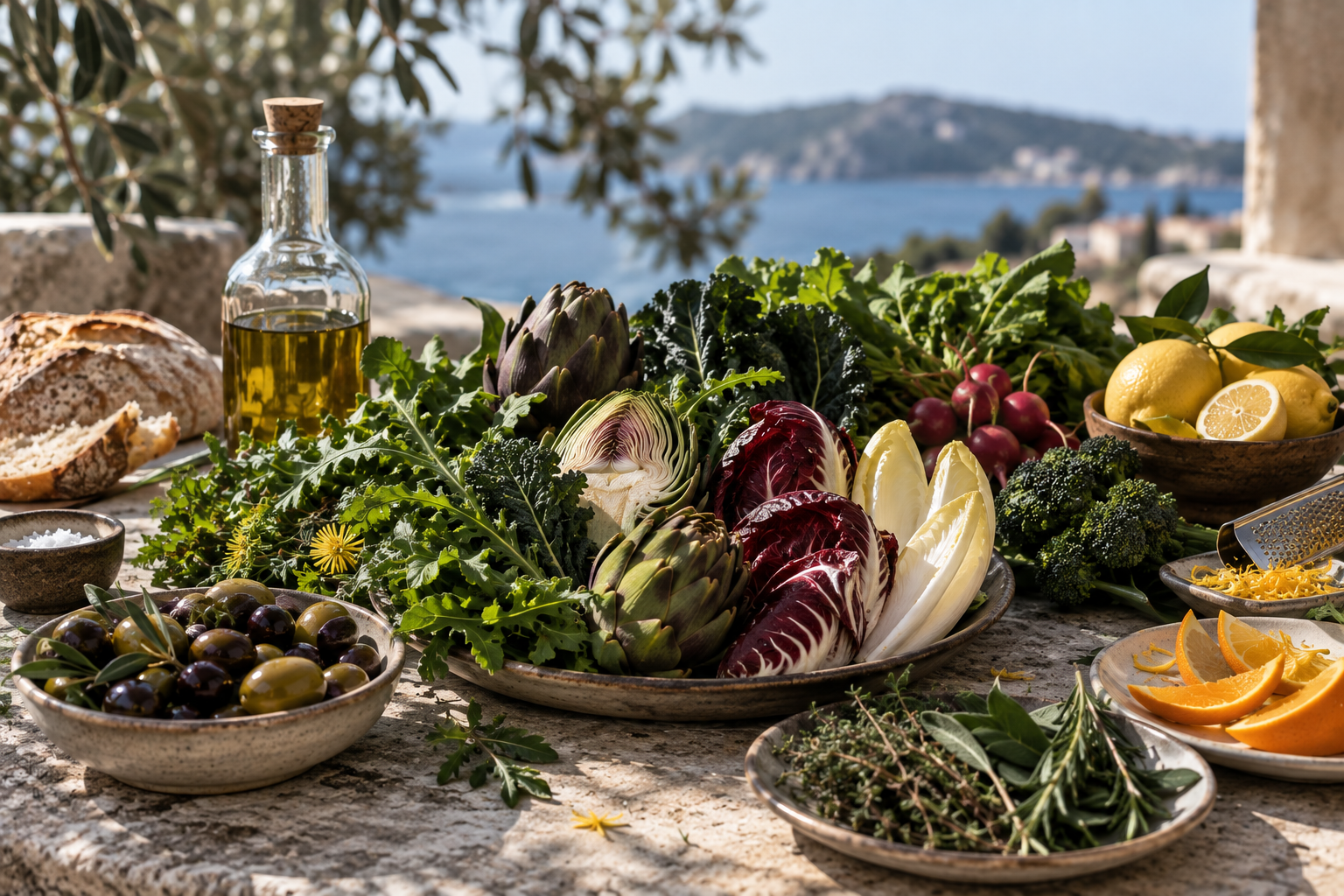
Think rocket, radicchio, chicory, endive, dandelion greens, artichoke, watercress, radish, broccoli and other brassicas, olives, good extra virgin olive oil, citrus zest and traditional wild greens such as horta.
And bitterness doesn't need to dominate the meal.
Traditional cooking gives us a lesson here too.
Bitter greens are often balanced with fat, acidity, salt and other flavours. Horta with olive oil and lemon is a perfect example. Radicchio works beautifully with olive oil and balsamic or citrus. Rocket can bring bitterness and pepperiness into an otherwise simple salad.
The goal isn't to eat the most bitter food you can tolerate.
It's to stop assuming every bitter flavour needs to be removed.
Bitter Doesn't Always Mean Better
There is another side to this story.
Our ability to recognise bitterness exists partly because some bitter compounds can be harmful.
So “bitter = medicinal” is not a safe rule.
Wild plants should never be consumed unless they have been correctly identified as edible, and concentrated herbal bitters have different pharmacological considerations from eating bitter vegetables as food.
This is particularly important when discussing gallbladder or biliary disease, gastrointestinal conditions, pregnancy or medications. A concentrated herbal extract designed to stimulate digestive or biliary activity is not physiologically equivalent to putting rocket on your plate.
This distinction is central to the idea of food as medicine.
Food can influence physiology without needing to be treated like a drug.
Food Is More Than Nutrients
Nutrition is often reduced to what we can quantify.
Protein. Carbohydrates. Fat. Fibre. Vitamins. Minerals.
All important.
But food also contains thousands of bioactive compounds, textures, aromas and flavours that interact with sensory receptors, digestive signalling pathways, the microbiome and our nervous system.
Bitterness gives us a beautiful example of that complexity.
The bitter taste of a leaf isn't simply something your tongue experiences.
It begins a conversation between food, receptors, the gut and the brain.
And we're still discovering just how extensive that conversation may be.
Sev's Final Thoughts
I love topics like this because they remind me that sometimes modern science doesn't replace traditional food wisdom.
It gives us another language through which to understand it.
Long before anyone knew what a TAS2R receptor was, people across the Mediterranean were gathering wild greens, cooking artichokes, eating olives and balancing bitter flavours with lemon and olive oil.
They weren't thinking about enteroendocrine cells, gut peptides or hepatic enzymes.
They were eating food that belonged to their landscape, their season and their culture.
Today, we have the privilege of looking at some of those traditions through a scientific lens, not to romanticise everything our ancestors did, but to ask why certain food practices persisted and what they might teach us.
And perhaps bitterness has something particularly relevant to teach us.
We've become very good at asking what we can remove from our diets.
Sugar. Gluten. Dairy. Carbs. Seed oils. Additives. Whatever happens to be under scrutiny that week.
Sometimes I think a more interesting question is:
What have we removed that might be worth bringing back?
A little bitterness may be one of those things.
Not because bitter foods are a detox cure.
Not because every bitter plant is medicinal.
But because food doesn't only provide nutrients.
Food also provides signals.
And bitter is one of them.
Sevim xx
