

From PCOS to PMOS: A New Name, A New Lens
There are some changes in healthcare that feel long overdue. For many of us working in women’s health, this is one of them.
In May 2026, Polycystic Ovary Syndrome, PCOS, officially became Polyendocrine Metabolic Ovarian Syndrome, or PMOS.
And I couldn’t be happier to see it.
Not because changing a name suddenly changes the condition, but because, finally, the name is beginning to reflect what this condition actually is.
For decades, women have been diagnosed with something called polycystic ovary syndrome — a name that immediately directs our attention towards two things: cysts and ovaries. Yet neither tells the whole story.
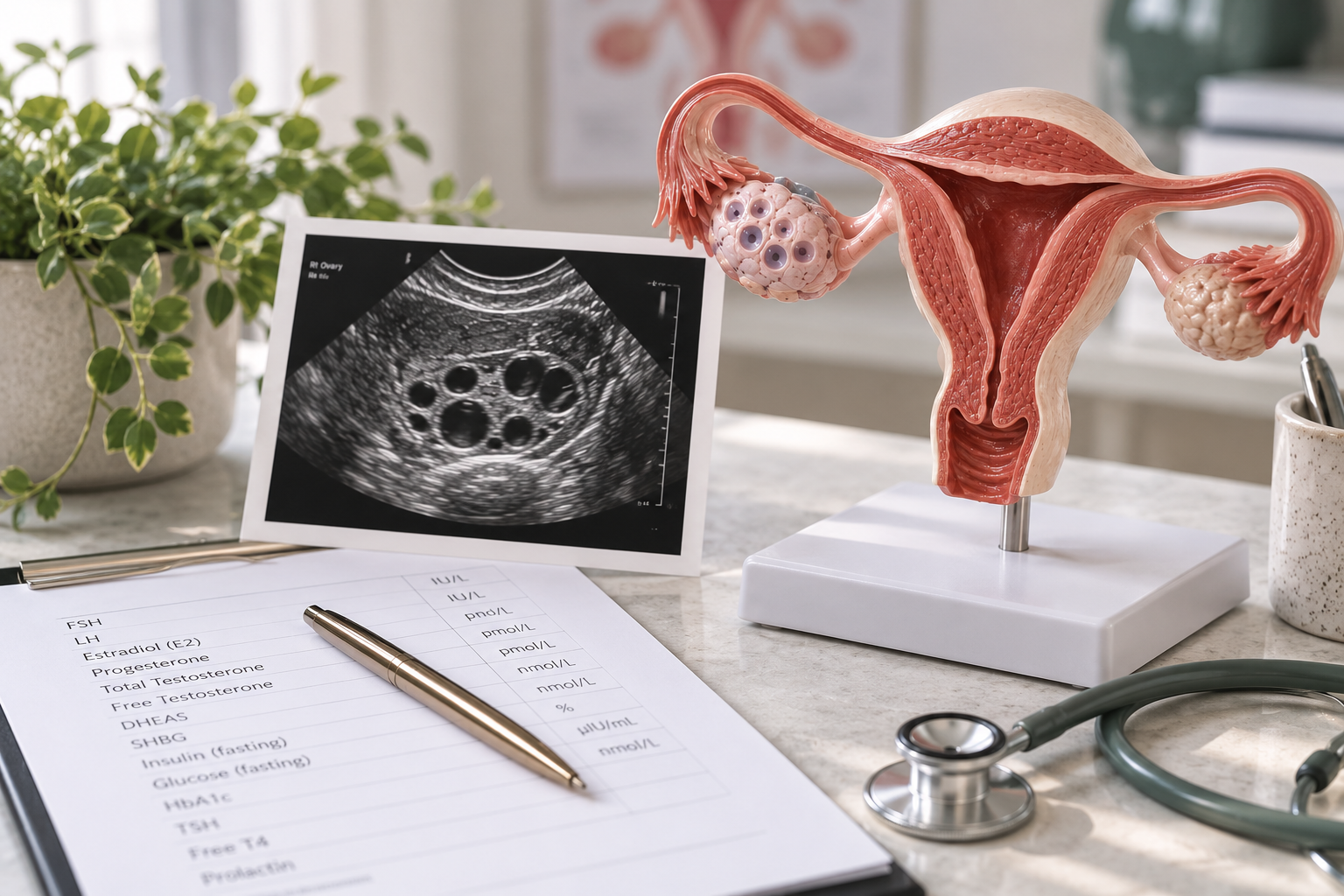
The so-called “cysts” aren’t actually abnormal pathological ovarian cysts. The characteristic appearance that can be seen on ultrasound reflects ovarian follicles. And the ovaries themselves are only one part of a much larger physiological picture.
PMOS can involve multiple interacting endocrine disturbances, ovarian function and metabolic health, with broader reproductive, cardiovascular, dermatological and psychological implications.
For me as a naturopath, this change feels particularly significant because it reflects something fundamental to the way I practise: the body cannot always be understood by looking at one symptom, one hormone or one organ in isolation.
It has never made sense to understand this condition by looking at the ovaries alone.
And now, finally, its name doesn’t ask us to.
Why Did PCOS Need a New Name?
The term polycystic ovary syndrome came from an understanding of the condition heavily influenced by what could be observed in the ovaries.
Our understanding has moved far beyond that.
One of the major problems with the old terminology was the word “polycystic.” Despite what the name suggested, PMOS is not defined by having numerous abnormal ovarian cysts growing on the ovaries. What has traditionally been described as a “polycystic” appearance relates to follicles and altered follicular development.
But the problem went deeper than terminology.
By placing the emphasis on polycystic ovaries, the name could encourage an ovarian and reproductive-centred understanding of a condition that extends well beyond reproduction.
The international renaming process recognised this. The new terminology was selected to better reflect the underlying pathophysiology while reducing confusion and recognising the condition’s broader health implications.
The new name gives us a very different starting point:
Polyendocrine. Metabolic. Ovarian. Syndrome.
Every word matters.
What Does PMOS Actually Mean?
Polyendocrine
Poly means many. Endocrine refers to the body’s hormonal signalling systems.
That first word immediately changes the way we think about the condition.
PMOS isn’t necessarily a problem with one isolated hormone. Androgen activity, insulin signalling, ovarian hormones and neuroendocrine signalling can all be involved, while the exact clinical pattern varies considerably between women.
This helps explain why two women with PMOS can look completely different clinically.
One may first seek help because her periods have become irregular. Another may be struggling to conceive. Another may experience acne, facial hair or scalp hair thinning. Another may discover abnormalities in glucose or metabolic markers. And another may experience several of these features simultaneously.
There isn’t one universal PMOS presentation.
Metabolic
This is perhaps the part of the new name I am happiest to see recognised so explicitly.
PMOS isn’t simply about menstruation and fertility.
Metabolic health matters.
Insulin resistance and compensatory hyperinsulinaemia are important features for many women with PMOS and can interact with androgen production and ovarian physiology. Metabolic considerations can also extend to glucose regulation, lipids, blood pressure and longer-term cardiometabolic health.
But adding the word metabolic doesn’t mean we should simply replace one reductionist view with another.
PMOS is not suddenly “an insulin problem” instead of “an ovarian problem.”
The point is that these systems interact. Metabolic function can influence endocrine and ovarian physiology, while hormonal and ovarian disturbances exist within that wider metabolic environment.
That is precisely why the word metabolic belongs in the name.
Ovarian
The ovaries still matter.
Follicular development, ovarian hormone production and ovulation can be altered in PMOS, contributing to menstrual irregularity, ovulatory dysfunction and fertility difficulties in some women.
But ovarian involvement is now positioned within the broader physiological picture.
It is part of the condition — not the entire identity of it.
The “Cysts” Were Never Really Cysts
This may be one of the most important misconceptions the name change helps clear up.
Despite the old name, PMOS does not mean that a woman has numerous pathological cysts growing on her ovaries.
The characteristic ovarian appearance associated with the condition reflects follicles, and ovarian morphology is only one component considered when assessing PMOS.
That distinction matters.
For years, women have heard confusing statements such as:
“You can’t have PCOS because you don’t have cysts.”
Or:
“You have cysts on your ovaries, so you must have PCOS.”
Neither reflects the complexity of diagnosis.
And perhaps this is our first clue that the condition was always much bigger than its old name suggested.
PMOS Is Not Just a Period Problem
Irregular periods may be one of the most visible signs that something is happening, but PMOS can present much more broadly.
Women may experience irregular or absent ovulation, menstrual irregularity, difficulty conceiving, acne, increased facial or body hair, scalp hair thinning or biochemical androgen excess. Metabolic abnormalities can also occur, while anxiety, depression and sleep-related concerns such as obstructive sleep apnoea are recognised as important aspects of the broader clinical picture.
Not every woman will experience every feature.
And that matters.
For a long time, the popular image of PCOS became almost a stereotype: irregular periods, weight gain, facial hair, acne and difficulty conceiving.
But real women don’t necessarily arrive with textbook presentations.
Someone can have PMOS in a smaller body. Another woman’s primary concern may be fertility, while someone else may have spent years treating acne without anyone asking what was happening with her cycle or wider endocrine health.
A diagnosis describes a condition. It does not describe the whole person experiencing it.
And this is where I think the new terminology gives us an opportunity to change the conversation entirely.
A New Name, A New Lens
For me, this is where the change from PCOS to PMOS becomes particularly meaningful.
Naturopathic medicine encourages us to look beyond an isolated symptom or organ and ask how different systems within the body may be interacting.
So when a woman presents with irregular periods, acne, difficulty ovulating, unwanted facial hair or changes in metabolic health, the question shouldn’t simply be:
“What’s wrong with the ovaries?”
We look wider.
What is happening with glucose regulation and metabolic health? What are the androgen patterns? Is ovulation occurring consistently? Are there other endocrine conditions that need to be considered? What is happening with sleep? Is she adequately nourished? What does movement look like? What medications is she taking? What does her medical and family history tell us?
And beyond pathology results and symptoms:
What is happening in her life?
What does she actually want help with? What is affecting her quality of life? What does she understand about her diagnosis? What has been overlooked?
Not because every one of these things causes PMOS, and certainly not because every woman with PMOS will have dysfunction in every one of these areas.
But because the person experiencing the condition is an interconnected biological system.
That is what makes the new name so significant to me.
Polycystic Ovary Syndrome directed our attention towards an organ.
Polyendocrine Metabolic Ovarian Syndrome asks us to consider the relationships between systems.
And that shift feels remarkably aligned with the way I was trained to think as a naturopath.
The Root Cause Perspective
The term “root cause” gets used frequently in natural medicine, but I think it is important to explain what I mean when I use it.
Looking for the root cause doesn’t necessarily mean believing that every health condition has one hidden cause waiting to be discovered.
Human physiology is rarely that simple.
PMOS is a perfect example.
Genetic susceptibility, neuroendocrine signalling, androgen excess, insulin resistance, metabolic factors and ovarian dysfunction can interact in complex ways, and the relative contribution of these factors may differ between women.
So from a naturopathic perspective, looking deeper isn’t necessarily about asking:
“What is the one thing that caused her PMOS?”
A more useful question is:
“What is contributing to this woman’s presentation of PMOS?”
That distinction is important.
Two women can share the same diagnosis while presenting very differently.
One may have prominent insulin resistance and hyperandrogenism. Another may primarily present with ovulatory dysfunction and fertility concerns. Another may first seek help because of acne or unwanted hair growth. Another may have lived with subtle signs for years without ever realising that they could be connected.
The diagnosis gives us a name. The individual gives us context.
And that is where personalised healthcare begins.
From Isolated Symptoms to Patterns
One of the things I love most about naturopathic practice is looking for patterns.
A period isn’t considered completely separately from metabolic health. Acne isn’t necessarily viewed only as a skin problem. Difficulty conceiving isn’t automatically separated from ovulation, endocrine function, nutritional status, metabolic health or the wider clinical picture.
Symptoms are important individually, but sometimes their relationship to one another tells us far more.
That doesn’t mean attributing every symptom a woman experiences to PMOS.
Quite the opposite.
A whole-person approach also means being willing to ask whether something isn’t PMOS.
Could another endocrine condition be contributing? Could a medication be affecting the picture? Is there another explanation for irregular menstruation or androgen excess? Does something require further medical investigation?
Holistic medicine should never mean assuming everything is connected to the same diagnosis.
It means being curious enough to investigate the whole picture.
Whole-Person Care Means Seeing the Connections
To me, holistic care means remembering that endocrine, reproductive, metabolic, cardiovascular, psychological and social health do not exist in separate boxes.
Interestingly, the science behind the PMOS name change itself reflects this broader understanding. The new terminology recognises interacting endocrine, metabolic and ovarian dysfunction rather than defining the condition predominantly by reproductive anatomy.
That doesn’t mean abandoning conventional investigation.
It means using it well.
Blood pathology, medical history, menstrual history, physical signs, imaging where appropriate and evidence-based diagnostic criteria all provide pieces of information.
But those pieces still belong to a person.
The pathology matters. The person carrying the pathology matters too.
That is the balance I believe good healthcare should strive for.
So Has the Condition Actually Changed?
No.
And this is an important part of the conversation.
Women didn’t suddenly develop a new condition in May 2026. The physiology didn’t change because the terminology did.
Nor were the endocrine and metabolic dimensions of PCOS unknown until now. They have been recognised and researched for many years.
What changed was the language.
The international consensus concluded that the old name no longer adequately represented the scientific understanding of the condition. PMOS was chosen to better capture its polyendocrine, metabolic and ovarian nature.
In other words:
the name is catching up with the science.
And names matter.
Because the way we name a condition influences the way patients understand it, the questions practitioners ask about it and, potentially, the areas of health that receive attention.
What Does This Mean for Care?
For me, the most exciting consequence isn’t a new treatment protocol.
It’s the possibility of a broader conversation.
A woman with PMOS shouldn’t only receive attention when she wants to become pregnant. Her menstrual and reproductive health matter. Her metabolic health matters. Her cardiovascular risk factors matter. Her skin and hair concerns matter. Her sleep matters. Her psychological wellbeing matters.
And her individual priorities matter.
The new terminology doesn’t give us a new protocol — nor does it suggest that every woman with PMOS requires the same approach.
From a naturopathic perspective, nutrition, movement, sleep, stress physiology, metabolic health, nutrient status and carefully selected nutritional or herbal medicines may form part of individualised care where clinically appropriate, alongside appropriate medical investigation and treatment.
But the purpose isn’t to throw every possible intervention at the diagnosis.
It’s to understand the person living with it.
Why This Name Change Matters
A diagnosis influences the way we understand ourselves.
And a name can influence the way we understand a diagnosis.
For decades, Polycystic Ovary Syndrome told women to look towards their ovaries — and often left them wondering where the “cysts” were.
Polyendocrine Metabolic Ovarian Syndrome gives us a much wider lens.
Not because everything we previously knew about PCOS was wrong. Far from it.
The endocrine and metabolic dimensions of the condition have been recognised scientifically for years. What feels significant now is that those dimensions are finally represented in the name itself.
And for those of us who practise through a whole-person lens, there is something incredibly meaningful about that.
Because the body was never functioning as separate departments in the first place.
The ovaries communicate with the brain. Hormones interact with metabolism. Metabolic signals can influence reproductive physiology. Sleep can influence metabolic and endocrine health. Psychological wellbeing can exist alongside — and be affected by — chronic health concerns.
And every one of those processes is occurring within a woman with her own genetics, environment, history, priorities and life.
That is the person we are treating. Not the acronym.
Sev’s Final Thoughts
As a naturopath, I find this change genuinely exciting.
Not because the metabolic and endocrine features of this condition have only just been discovered. They haven’t. They have been recognised and researched for many years.
What feels significant is that the name has finally caught up with the complexity of the condition.
For those of us trained to look at the person as a whole, there is something deeply significant about seeing a condition once defined almost entirely by an organ now described in language that better acknowledges its interconnected physiology.
Polyendocrine. Metabolic. Ovarian.
Not one hormone.
Not one organ.
Not one symptom.
And certainly not one type of woman.
To me, that’s the real opportunity in this change.
We get to reintroduce PMOS.
To women who were diagnosed years ago but were never really taught what was happening in their bodies. To women who never recognised themselves in the traditional PCOS stereotype. And to a new generation of women who can hopefully understand this condition from the beginning through a much wider lens.
The diagnosis gives us a name. Understanding the whole person gives us context.
And perhaps PMOS finally gives us language that allows us to do both.
Sevim xx
References & Further Reading
The primary sources for the terminology change and current clinical framework are the 2026 international PMOS materials from Monash University — International Evidence-Based PMOS Guideline and the Endocrine Society — PMOS Name Change Announcement. The updated international document explains the scientific rationale behind each component of the new name — polyendocrine, metabolic and ovarian — and the transition from PCOS to PMOS.
