

Garlic: One of Nature's Most Powerful Medicines
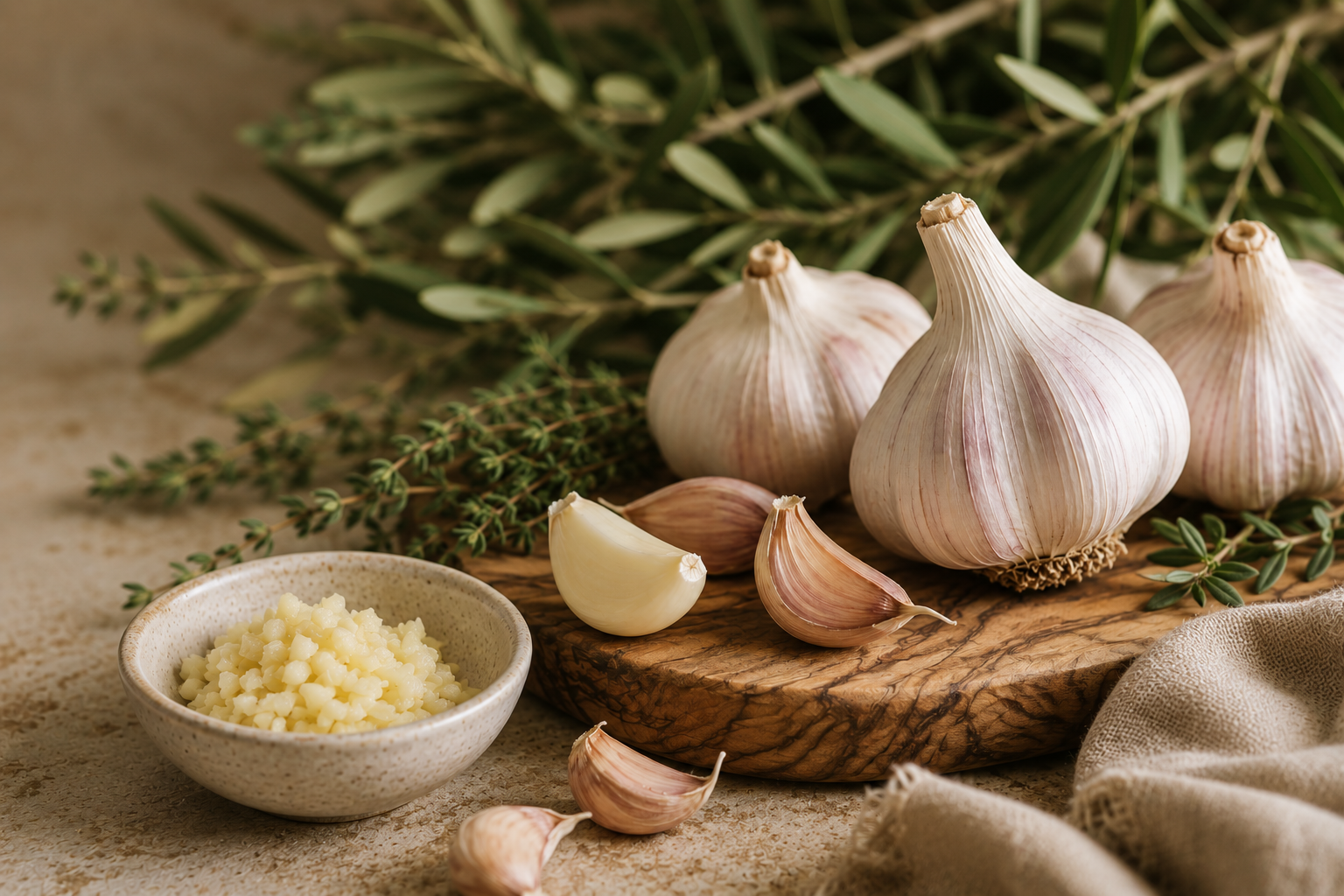
If you grew up in a Mediterranean household like I did, garlic was never simply an ingredient.
It was medicine.
A clove of garlic added to soups during winter. Raw garlic crushed into dressings and dips. Garlic gently simmered in olive oil. And, of course, the familiar advice from parents and grandparents:
"Eat some garlic — it'll help."
For thousands of years, traditional cultures around the world have recognised garlic (Allium sativum) as both food and medicine. Long before modern laboratories existed, garlic was used to support immunity, fight infections, aid digestion, promote circulation, and maintain vitality.
Today, modern science is beginning to reveal just how remarkable this humble plant truly is.
In fact, garlic is now one of the most extensively researched medicinal foods on the planet.
Yet despite this, most people unknowingly destroy many of garlic's most beneficial compounds before it ever reaches the plate.
The Science Behind Garlic
Much of garlic's medicinal activity comes from a sulphur-containing compound called allicin.
Interestingly, fresh garlic doesn't actually contain allicin.
When a garlic clove is chopped, crushed, or chewed, an enzyme called alliinase converts a precursor compound called alliin into allicin.
This is where things become fascinating.
Allicin is largely responsible for many of garlic's antimicrobial and therapeutic effects, but it is also highly unstable.
Heat can rapidly reduce the activity of the enzyme responsible for producing allicin.
In practical terms, this means that if you finely chop garlic and immediately throw it into a hot frying pan, you may significantly reduce the amount of allicin ultimately produced.
So how can you maximise garlic's benefits?
Research suggests that allowing chopped or crushed garlic to sit for approximately 10 minutes before cooking gives the enzyme enough time to generate allicin before heat exposure occurs.
Simply:
Chop → wait → cook.
Such a simple practice may dramatically increase the medicinal potential of the garlic already sitting in your kitchen.
Garlic as Nature's Antimicrobial
One of garlic's best-studied actions is its antimicrobial activity.
Research suggests that garlic and its active constituents may inhibit or reduce the growth of a wide range of microorganisms, including:
Bacteria such as Helicobacter pylori, Staphylococcus aureus, and Escherichia coli
Certain fungal species, including Candida albicans
Some viruses involved in common respiratory infections
Various parasites and gastrointestinal pathogens
From a traditional perspective, this helps explain why garlic was so commonly used during periods of illness long before antibiotics existed.
But garlic's story doesn't end there.
Garlic and the Gut Microbiome
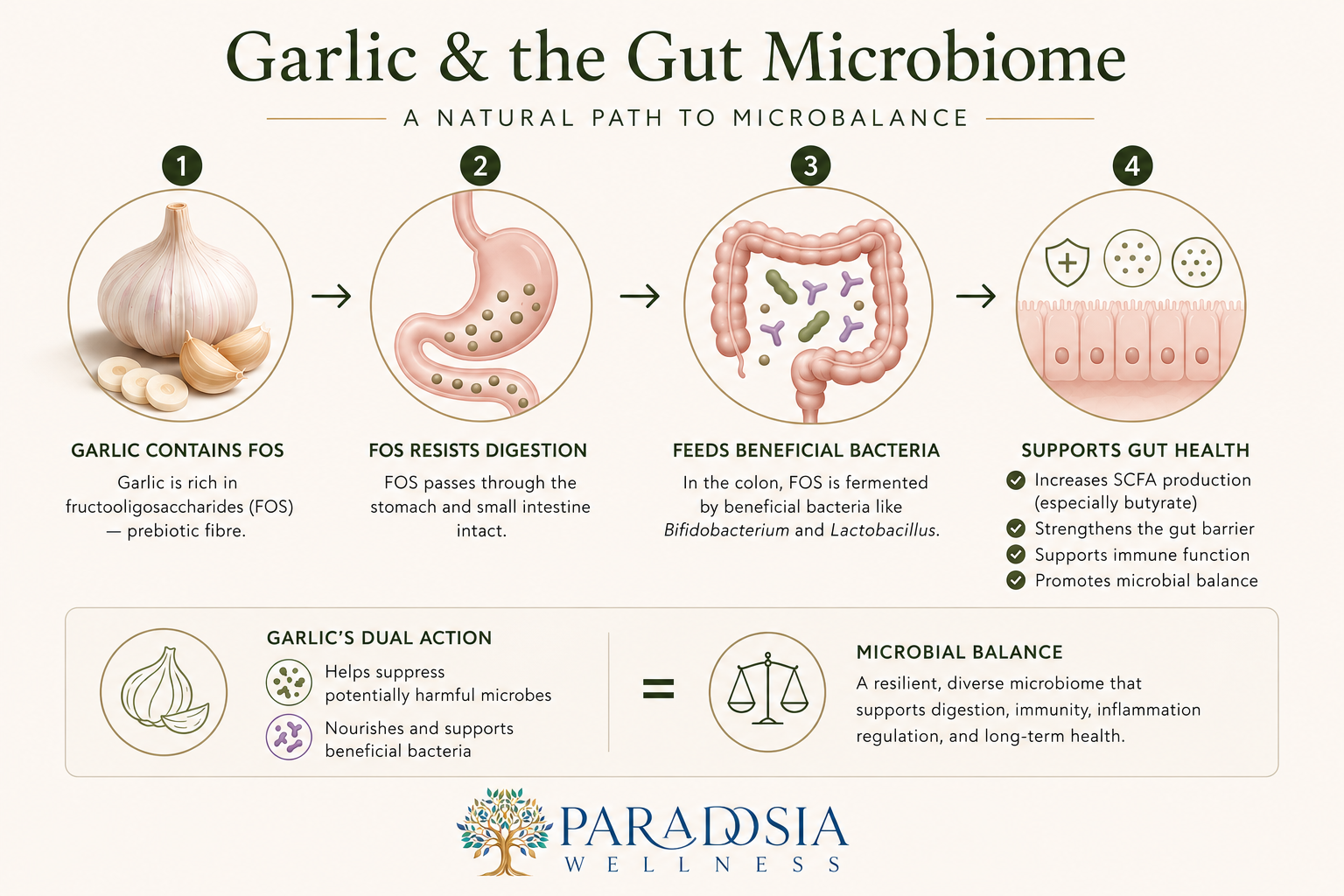
One of the most compelling areas of modern research is garlic's dual role within the gut ecosystem.
Garlic contains fructooligosaccharides (FOS) — a class of fermentable fibres that act as prebiotics. These compounds resist digestion in the upper gastrointestinal tract and reach the colon intact, where they are selectively fermented by beneficial bacteria.
Studies have shown that FOS from garlic can promote the growth of key microbial species such as Bifidobacterium and Lactobacillus. These bacteria are associated with improved gut barrier integrity, production of short-chain fatty acids (SCFAs), and modulation of immune signalling within the gut.
Short-chain fatty acids — particularly butyrate — play a critical role in maintaining the health of colonocytes (cells lining the colon), regulating inflammation, and supporting the integrity of the intestinal barrier.
What makes garlic particularly unique is its selective antimicrobial activity.
While compounds like allicin can inhibit pathogenic organisms, they appear to have a less detrimental effect on beneficial commensal bacteria when consumed as part of whole food intake. This creates a fascinating dynamic:
Suppression of potentially harmful microbes
Simultaneous nourishment of beneficial species
This dual action supports what we refer to as microbial balance, rather than indiscriminate eradication.
Additionally, garlic-derived sulphur compounds may influence quorum sensing — the communication system bacteria use to coordinate behaviour such as biofilm formation. By disrupting these signalling pathways, garlic may reduce the ability of pathogenic bacteria to establish persistent colonies within the gut.
From a clinical perspective, this positions garlic as more than just an antimicrobial agent.
It acts as a microbiome modulator — supporting resilience, diversity, and balance within the gut ecosystem.
And increasingly, we understand that a resilient microbiome underpins not only digestive health, but immune function, inflammation regulation, and even long-term disease risk.
Beyond Infection: What Else Is Garlic Good For?
Cardiovascular Health
Garlic is one of the most extensively studied medicinal foods in cardiovascular research.
Its benefits are largely attributed to a range of sulphur-containing compounds, including allicin, diallyl disulfide, and S-allyl cysteine (SAC) — a stable compound found in aged garlic extract.
SAC has been extensively studied for its ability to:
Reduce oxidative stress within blood vessels
Improve endothelial function (the ability of blood vessels to dilate properly)
Support nitric oxide production, which enhances vascular relaxation
Reduce LDL oxidation — a key step in the development of atherosclerosis
Clinical studies and meta-analyses have demonstrated that garlic supplementation can contribute to:
Modest reductions in blood pressure
Improvements in lipid profiles
Enhanced arterial elasticity
Garlic also supports healthy circulation by influencing platelet function and blood flow dynamics, contributing to overall cardiovascular resilience.
Immune Resilience
Garlic's impact on the immune system is both profound and multifaceted.
Rather than simply "boosting" immunity, garlic acts as an immunomodulator, meaning it helps regulate immune responses in a balanced and adaptive way.
Key mechanisms include:
Activation of immune cells: Garlic compounds have been shown to enhance the activity of macrophages, natural killer (NK) cells, and lymphocytes — all critical components of the body's defence system.
Cytokine modulation: Garlic influences the production of cytokines, the signalling molecules that coordinate immune responses. It can help promote appropriate inflammatory responses when needed, while also preventing excessive or chronic inflammation.
Antiviral activity: Allicin and related compounds can interfere with viral replication and entry into host cells.
Antioxidant protection: Garlic reduces oxidative stress, which is closely linked to immune dysfunction and chronic inflammation.
Clinical trials have demonstrated that individuals consuming garlic regularly experience fewer colds and recover more quickly when they do become ill.
This is not simply due to antimicrobial effects — it reflects garlic's ability to enhance the efficiency and coordination of the immune system itself.
Healthy Ageing and Longevity
Garlic's role in longevity is one of its most compelling attributes.
Rather than targeting a single pathway, garlic influences multiple biological processes associated with ageing — often referred to as the hallmarks of ageing.
Key mechanisms include:
Reduction of oxidative stress: Garlic compounds, particularly SAC, act as potent antioxidants, neutralising free radicals and protecting cellular structures from damage.
Anti-inflammatory effects: Chronic low-grade inflammation is a major driver of ageing and disease. Garlic helps regulate inflammatory pathways, including NF-κB signalling.
Support of mitochondrial function: Emerging research suggests garlic may help preserve mitochondrial efficiency, which is essential for energy production and cellular vitality.
Vascular protection: By improving endothelial function and reducing arterial stiffness, garlic supports long-term cardiovascular health — a key determinant of lifespan.
Detoxification support: Sulphur compounds in garlic enhance phase II liver detoxification pathways, particularly glutathione production, which is critical for cellular defence and repair.
In populations known for longevity — including Mediterranean regions and Blue Zones — garlic is not consumed as a supplement, but as a daily dietary staple.
Its consistent, low-dose exposure over time may contribute to cumulative protective effects across multiple systems in the body.
This is where garlic truly shines.
Not as a quick fix, but as a foundational longevity food.
Food First
One of the things I love most about garlic is that it perfectly embodies one of the core principles of naturopathic medicine:
Food as medicine.
You don't necessarily need an expensive supplement to benefit from garlic.
Regularly incorporating freshly prepared garlic into soups, dressings, roasted vegetables, legumes, sauces, marinades, and everyday meals may provide meaningful health benefits over time.
Garlic reminds us that some of the most powerful medicines are not exotic, expensive, or difficult to access.
Sometimes they have been quietly sitting in our kitchens all along.
Practical Ways to Harness Garlic's Benefits
Crush or chop fresh garlic and allow it to sit for approximately 10 minutes before cooking.
Add garlic toward the end of cooking where possible to preserve more active compounds.
Use fresh garlic regularly as part of a whole-food dietary pattern.
Consider different garlic preparations depending on the intended therapeutic goal.
Sev's Final Thoughts
Garlic is a beautiful example of where traditional wisdom and modern science intersect.
For generations, our ancestors used garlic because they observed its effects. Today, research continues to reveal the remarkable complexity behind those observations.
Perhaps this is why traditional food cultures remain so valuable. They remind us that medicine doesn't always arrive in a capsule or prescription bottle.
Sometimes, it begins with a humble clove of garlic, shared around the family table.
Sevim xx
