

The Cycle Series (Part III): Ovulation — Your Monthly Superpower

In Part II of The Cycle Series, we followed the body from menstruation through the follicular phase — watching FSH stimulate follicle development, estrogen begin to rise, and the body gradually prepare for what comes next.
Ovulation.
Most of us were taught a very simplified version of ovulation: once a month, an egg is released, and that's when you can get pregnant.
And while that's technically true, it barely scratches the surface.
Ovulation is the culmination of an extraordinary conversation between your brain and ovaries. It requires coordinated hormonal signalling, a developing follicle, rising estrogen, an LH surge, and finally the release of a mature egg.
But perhaps the most overlooked part is what happens after the egg leaves.
That empty follicle doesn't simply disappear.
It transforms into a temporary endocrine gland called the corpus luteum, which begins producing progesterone, the dominant hormone of the luteal phase.
So no, ovulation isn't only important if you're trying to conceive.
It's a significant physiological event that gives us valuable information about menstrual and reproductive function, and understanding it can completely change the way you look at your cycle.
What Actually Happens During Ovulation?
Ovulation doesn't happen because the calendar reaches Day 14.
It happens because a very specific hormonal sequence has taken place.
During the follicular phase, FSH (follicle-stimulating hormone) encourages a group of ovarian follicles to develop. Usually, one becomes the dominant follicle and continues maturing.
As that follicle grows, it produces increasing amounts of estradiol, the predominant form of estrogen during the reproductive years.
For most of the follicular phase, estradiol exerts predominantly negative feedback on the hypothalamus and pituitary gland.
But as the dominant follicle matures and estradiol remains sufficiently elevated, something remarkable happens:
The feedback shifts from negative to positive.
Instead of suppressing reproductive signalling, sustained high estradiol triggers positive feedback, resulting in a dramatic surge of LH (luteinising hormone) from the pituitary gland.
The LH surge initiates the final maturation of the egg and changes within the follicle that eventually cause it to rupture.
And then:
Ovulation occurs.
The mature egg is released from the ovary and captured by the finger-like fimbriae at the end of the fallopian tube, where it begins its journey through the tube and may be fertilised if sperm are present.
The egg itself remains viable for only around 12–24 hours after ovulation.
Sperm, however, can survive within the female reproductive tract for up to around five days under favourable conditions, which is why the fertile window begins before ovulation rather than only on the day the egg is released.
The Hormonal Journey to Ovulation
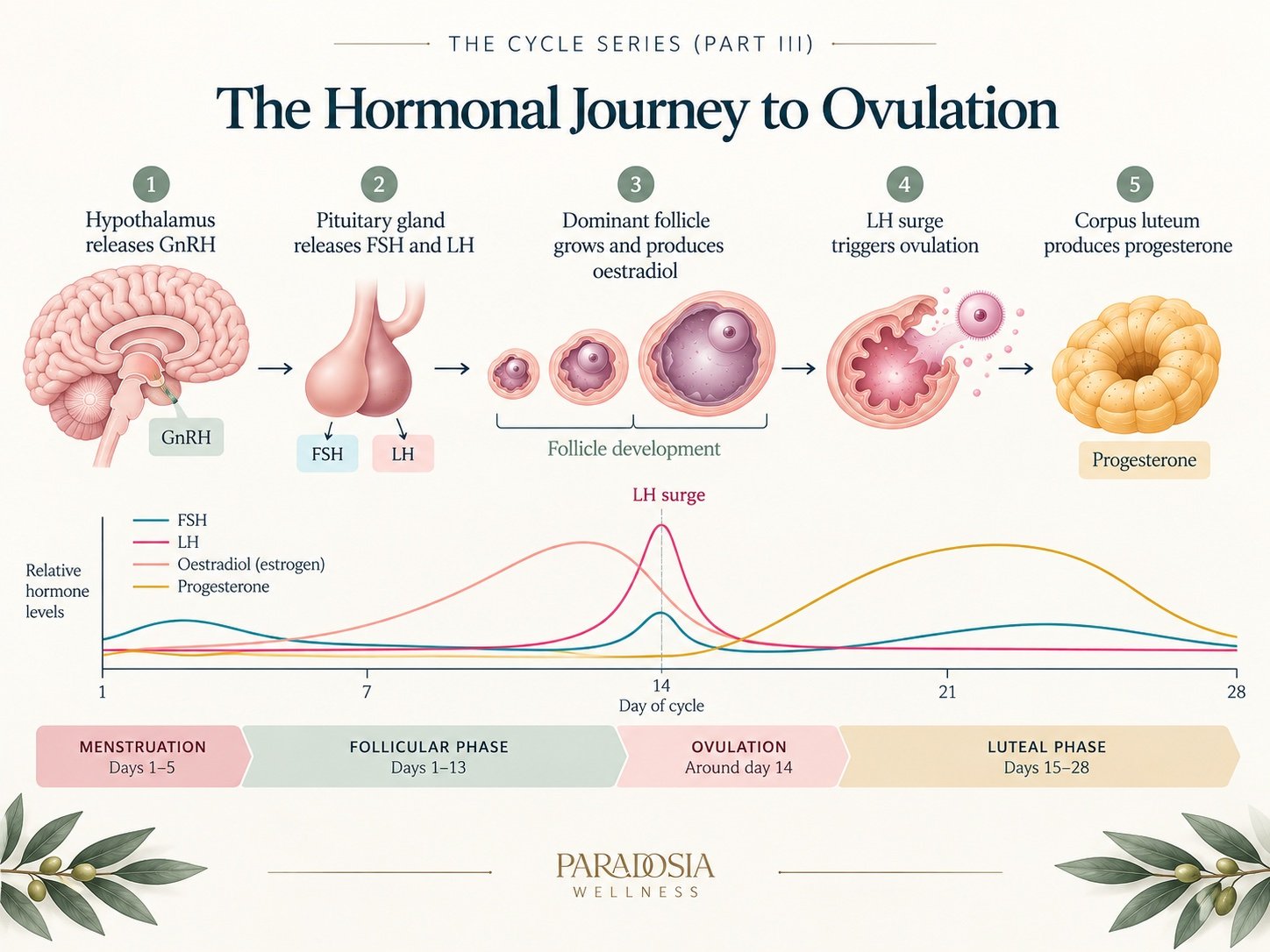
If we zoom out, the sequence looks something like this:
Hypothalamus → GnRH → Pituitary → FSH + LH → Follicle development → Estradiol rises → LH surge → Ovulation
This is the hypothalamic–pituitary–ovarian (HPO) axis we introduced in Part II.
And it matters because ovulation isn't simply an ovarian event.
The brain is involved.
The pituitary is involved.
The ovaries are involved.
Energy availability, thyroid and prolactin signalling, age and reproductive health can all influence whether this sequence occurs normally.
Your cycle is a conversation, and ovulation is one of its most important events.
The Part Nobody Talks About: The Corpus Luteum
Once the egg has been released, the follicle that housed it undergoes an extraordinary transformation.
It becomes the corpus luteum.
Think of it as a temporary hormone-producing gland created by ovulation itself.
Its major job is to produce progesterone, although it also produces estrogen and other signalling molecules.
Progesterone then becomes the dominant hormone of the luteal phase.
It transforms the estrogen-primed endometrium into a more secretory, receptive environment capable of supporting implantation if conception occurs.
It also produces one of the most useful signs that ovulation has happened:
Your basal body temperature rises.
Progesterone has a thermogenic effect, meaning body temperature typically increases slightly after ovulation and remains elevated throughout much of the luteal phase.
If pregnancy doesn't occur, the corpus luteum eventually regresses.
Progesterone and estrogen fall.
The endometrial lining can no longer be maintained.
And menstruation begins.
The cycle starts again.
Why Ovulation Matters Even If You Don't Want a Baby
This is the part I wish more women were taught.
We tend to treat ovulation as though its only biological purpose worth discussing is pregnancy.
But an ovulatory menstrual cycle also creates the hormonal environment of the luteal phase.
Without ovulation, there is no functioning corpus luteum, and therefore no normal post-ovulatory rise in progesterone.
That distinction matters.
Estrogen and progesterone don't act only on the reproductive organs. Their receptors are found throughout the body, including in the brain, bone and other tissues.
Estradiol plays an important role in maintaining bone health, while ovulation creates the corpus luteum and the characteristic progesterone exposure of the luteal phase.
This is one reason regular ovulatory menstrual function during the reproductive years can provide useful information about the functioning of the HPO axis and overall reproductive health.
This doesn't mean that every irregular or anovulatory cycle signals poor health. Life stage, breastfeeding, hormonal contraception, perimenopause, illness and many other circumstances can change ovulatory patterns.
But when ovulation unexpectedly becomes irregular or disappears, it is worth asking why.
Because sometimes the cycle is telling us something before we have thought to look elsewhere.
Having a Period Doesn't Always Mean You Ovulated
This surprises a lot of women.
Bleeding is not necessarily proof of ovulation.
In a typical ovulatory menstrual cycle:
Ovulation → corpus luteum → progesterone rises → corpus luteum regresses → progesterone falls → menstruation
But bleeding can also occur without ovulation.
This is known as anovulatory bleeding.
Without ovulation, a normal corpus luteum doesn't form, and there isn't the typical luteal-phase progesterone pattern.
The endometrium may still build under estrogenic stimulation and eventually become unstable and shed, producing bleeding that can look like a period.
This is one reason simply tracking bleeding dates doesn't always tell us the whole story.
It's also important to distinguish a natural menstrual bleed from withdrawal bleeding on hormonal contraception. Depending on the contraceptive method, ovulation may be suppressed, and the scheduled bleed is caused by changes in externally supplied hormones rather than the hormonal sequence of a spontaneous ovulatory cycle.
That isn't inherently harmful — it's simply different physiology.
And women deserve to understand the difference.
How Do You Know If You're Ovulating?
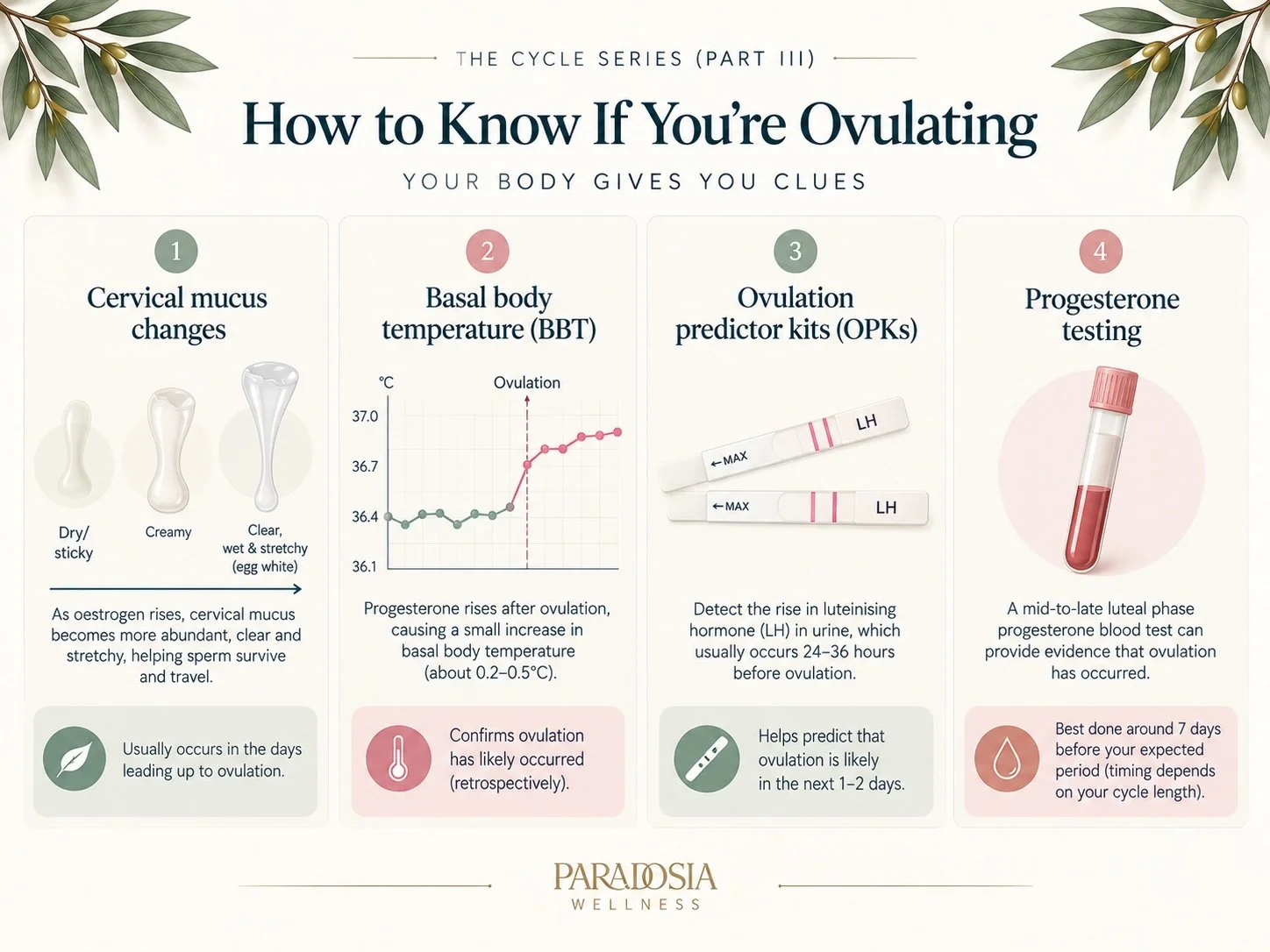
Your body gives us clues.
Cervical Mucus
As estrogen rises approaching ovulation, cervical mucus typically becomes wetter, clearer, more slippery and more stretchy.
You may have heard it described as egg-white cervical mucus.
This isn't random.
Estrogen changes the cervical environment to create mucus that helps sperm survive and travel through the reproductive tract.
For someone learning fertility awareness, cervical mucus can provide useful real-time information that ovulation may be approaching.
Basal Body Temperature
After ovulation, rising progesterone causes a small increase in basal body temperature.
Tracking your temperature every morning can therefore help identify a sustained thermal shift consistent with ovulation having occurred.
The important distinction is:
Cervical mucus can help tell us ovulation may be approaching.
Basal body temperature helps confirm it retrospectively.
Ovulation Predictor Kits
Ovulation predictor kits detect the rise in LH that usually occurs shortly before ovulation.
They can be useful, particularly when trying to conceive, but they predict rather than confirm ovulation. An LH surge indicates that ovulation is likely approaching, but it doesn't prove that an egg was successfully released.
This is especially relevant in conditions such as Polyendocrine Metabolic Ovarian Syndrome (PMOS), formerly known as PCOS, where LH patterns can sometimes make interpretation more difficult.
Progesterone Testing
Progesterone can also be measured during the luteal phase to provide evidence that ovulation has occurred.
But here's something important:
“Day 21 progesterone” is not automatically appropriate for every woman.
That timing assumes something close to a 28-day cycle with ovulation around Day 14.
A more individualised approach is to assess progesterone approximately one week before the expected period, based on the person's cycle and suspected timing of ovulation.
This is exactly why understanding your own cycle matters more than simply following calendar rules.
What Can Disrupt Ovulation?
Ovulation requires coordinated endocrine signalling, so many different factors can interfere with it.
Factors that can disrupt or suppress ovulation include:
Polyendocrine Metabolic Ovarian Syndrome (PMOS)
Low energy availability from insufficient food intake relative to the body's needs
Significant weight loss
Excessive or intensive exercise, particularly when combined with inadequate energy intake
Psychological or physiological stress
Thyroid dysfunction
Elevated prolactin
Perimenopause and reproductive ageing
Certain medications
Pregnancy and breastfeeding
Hormonal contraception, depending on the method
And this is where I think the concept of “hormone balance” often becomes far too simplistic.
Sometimes the answer isn't another hormone supplement.
Sometimes the body needs more energy.
Sometimes it needs investigation.
Sometimes the thyroid needs attention.
Sometimes prolactin is elevated.
Sometimes PMOS is interfering with normal follicular development.
Sometimes we're simply entering a different reproductive life stage.
The question shouldn't only be:
“How do I make myself ovulate?”
It should also be:
“Why isn't ovulation happening consistently in the first place?”
That is the root-cause conversation.
When the Body Doesn't Have Enough Energy
This deserves its own section because it is so often missed.
Reproduction is energetically expensive.
The reproductive system is sensitive to signals of energy availability, metabolic status and physiological stress.
When energy availability becomes chronically inadequate, whether through under-eating, restrictive dieting, heavy training, significant weight loss or a combination of factors, hypothalamic signalling can change.
GnRH pulsatility can be disrupted.
LH and FSH signalling can change.
Follicular development may be impaired.
And ovulation can become irregular or stop altogether.
This can occur in women who don't “look underweight.”
It isn't simply about body size.
It is about energy availability relative to what the body is being asked to do.
And sometimes one of the most therapeutic things we can do for hormonal health isn't to restrict more.
It's nourish more.
What About Stress?
Stress and ovulation have a complicated relationship.
One stressful day isn't going to suddenly “switch off” your reproductive system.
But significant or prolonged physiological and psychological stress can influence the HPO axis and, in some circumstances, alter cycle timing or contribute to disrupted ovulation.
This is why I don't like reducing hormonal health to a single organ.
Your ovaries don't exist in isolation from your brain, thyroid, metabolism, sleep or nutritional status.
The whole system communicates.
Supporting Healthy Ovulation
There is no universal “ovulation protocol.”
The first question is always whether there is actually a problem, and if there is, what is driving it?
But some of the foundations I think about include:
Nourish Enough
Adequate energy intake matters.
So does dietary quality.
Protein, essential fatty acids, carbohydrates and micronutrients all contribute to the enormous amount of biological work involved in hormone synthesis, follicular development and normal reproductive function.
For many women, constantly eating less isn't the answer.
Build Nutrient Density
Nutrients involved in reproductive function, thyroid physiology, energy metabolism, red blood cell production and broader hormonal health include:
Iron
Zinc
Magnesium
Folate
Vitamin B6
Vitamin B12
Vitamin D
Iodine
Selenium
Omega-3 fatty acids
That doesn't mean every woman needs all of these as supplements.
Food comes first, and supplementation should be based on dietary intake, clinical context, medications and, where appropriate, testing.
Support Metabolic Health
For women with insulin resistance or PMOS, improving metabolic health can be an important part of supporting more regular ovulatory cycles.
This may involve nutrition, movement, resistance training, sleep, stress management and appropriately selected nutritional or medical interventions.
Again:
The treatment depends on the driver.
Support the Nervous System
Reproductive physiology doesn't exist separately from the nervous system.
Consistent sleep, adequate recovery, appropriate movement, time outdoors, social connection and strategies that help regulate chronic stress can all form part of the wider environment supporting hormonal health.
None of these is a magical “hormone hack.” The point is to recognise that reproductive function exists within the physiology of the whole person.
Herbal Medicine
Herbal medicine may also have a place when selected for the individual, rather than prescribed as a generic “female hormone” protocol.
Medicines such as Vitex agnus-castus, Paeonia lactiflora and other reproductive herbs may be considered depending on the clinical picture, but the appropriate choice depends on why ovulation is disrupted in the first place.
Anovulation associated with PMOS is not the same clinical picture as functional hypothalamic amenorrhoea. Elevated prolactin is not the same as thyroid dysfunction. Perimenopause is not the same as inadequate energy availability.
The same herb is not appropriate for every woman simply because the symptom is “irregular periods.”
Treat the person, not the hormone chart.
When Should You Investigate?
Occasional cycle variation happens.
But it's worth seeking appropriate assessment when cycles become persistently irregular, periods stop unexpectedly, there are signs of androgen excess such as new or worsening facial hair or acne, you experience unexpected nipple discharge, or you're having difficulty conceiving.
Investigation may involve looking at:
cycle history and ovulation patterns
pregnancy where relevant
thyroid function
prolactin
androgen levels
metabolic markers
nutritional status
energy availability
symptoms of PMOS
reproductive stage and age
medications
and, where appropriate, pelvic ultrasound or further medical assessment
The aim isn't to obsess over every hormonal fluctuation.
It's to understand the pattern.
Sev's Final Thoughts
I think ovulation is one of the most underappreciated events in women's health.
We're taught about it almost exclusively in the context of pregnancy, either how to achieve it or how to prevent it.
But understanding ovulation gives us something much bigger:
a window into our physiology.
It reveals the incredible conversation taking place between the brain and ovaries. Ovulation creates the corpus luteum and, with it, the progesterone-rich hormonal environment of the luteal phase. And when ovulation unexpectedly becomes irregular or disappears, it gives us a reason to ask why.
Not to blame the body.
To understand it.
Because your cycle isn't just something that happens to you every month.
It's something you can learn to read.
And the more you understand the language of your body, the easier it becomes to recognise when it's thriving, and when it might need a little more support.
That's the real superpower.
Sevim xx
